I am reading a book titled Utsumi Nobuyuki: Hana to Hansen no Shijin (Nobuyuki Utsumi: Poet loving flowers and hating wars*) written by Toshikazu Yasumizu in 2007. Nobuyuki Utsumi was a poet from Tatsuno City, which is situated next to Himeji City.
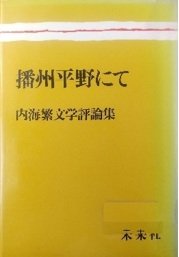
I will write about this book after I finish reading it. In this blog, I’m going to write about a book titled Banshu Heiya Nite - Utsumi Shigeru Bungaku-hyoronshu (Thinking on the Banshu Plain: A Collection of Literary Criticism *) by Shigetu Utsumi in1983. Shigeru is the second son of Nobuyuki.
Although this book was introduced on the page of "Local History and Works by Local Literary Figures" in the presentation “Himeji Wartime History Viewed Through Books” created by us and can be read via the link posted in this website, I would like to repost an essay and listen to what he, Shigeru Utsumi really wanted to tell us through the book as I have come to know more about his father.
Shigeru Utsumi lived in Himeji during the Pacific War and experienced both of the air raids on Himeji. In a memoir contributed to the book, Himeji Kubaku no Kiroku – Kyohuno Hiru to Yoru (Records of Air Raids on Himeji-Terrible Day and Night*) (1973), he describes the horror of those attacks. After the war, he played a leading role in various social movements, including helping to establish the Himeji Cultural Federation, which was chaired by Tomoji Abe, a prominent author.
In the chapter "Recollections of My Father, Nobuyuki Utsumi" from the Banshu Heiya Nite, Shigeru writes the following:
"Nobuyuki denounced absolutism and militarism as they cause only adverse consequences for Japan like cancers. Since I was an elementary school boy, I was taught that absolutism was going to be the root cause of Japan’s misfortunes and that war was the worst crime against humanity."
Now, let’s talk about the book. In pages 181 through 200 (from the Chapter 8, "Issues in communicating war experience" to Chapter 11, "December 8th and literary person" of Part II, "Various thoughts on literature"), he argues that there is another facet of war that must be recounted and passed on in order to keep peace.
Shigeru Utsumi observes a significant gap in perspective between those who lived through the war and now seek to share their harrowing experiences and the postwar generation who listen to these accounts.
He notes that younger people often respond with comments like, "Why didn't you oppose the war? If I had been conscripted, I would have run away—that’s what I would have done." Utsumi feels that these younger individuals lack a realistic understanding of what the war is like. At the same time, he urges those who try to share their harsh stories to provide a vivid, authentic account rooted in the everyday realities of that time.
Utsumi expresses concern that the accounts of those who lived through the war rarely mention the abnormality of their daily lives. Instead, they often say with a sense of resignation, “That was just the kind of era it was" or "It couldn't be helped." This may suggest that the indoctrination imposed upon the public by the government at that time was exceptionally oppressive. Utsumi worries, however, that we Japanese might be vulnerable—lacking sufficient resistance—to such indoctrination by those in power.
Furthermore, in Chapter 11, titled "December 8th and literary person," he cites a collection of poetry, Daitoa Seisen Siikashu-Taisho no Motoni (Anthology of Greater East Asia Holy War-Under the Imperial Edict*) published in February 1942, shortly after the outbreak of the Pacific War. Prominent cultural figures contributed poems, some were in the form of tanka (31-syllable poet) and haiku (17-syllable poet) that collectively glorified the war. Regarding this, Utsumi writes the following—paragraph in the middle of page 199—thereby concluding the chapter on the war.
“Among those cultural figures, many were forced to create such things—whether as a form of "test of allegiance" or as a way to establish an alibi for their own and their families’ safety. I believe it is necessary to understand and accept what they did as something that cannot be helped. After all, once this kind of situation has enveloped the society, it is too late; what is truly necessary is to break through the circumstances before they reach that point.”
Based on these accounts, Utsumi appears to be urging us—the postwar generation—to re-examine why, throughout the period spanning the Second Sino-Japanese War and the Pacific War, the vast majority of the population—children included—threw themselves into the "total national mobilization" and supported conduct of war without a shred of doubt. He suggests that this was the result of a thorough ideological indoctrination imposed by the government, while those intellectuals and cultural figures who remained resistant to such indoctrination were silenced through the brutal enforcement of the Peace Preservation Law. This, in Utsumi’s view, represents another dimension of the war.
When reading books regarding the wartime in early Showa-period, I often encounter the memoirs of individuals who were children or teenagers during those days. What surprises me is that, despite enduring harrowing experiences—such as mass evacuations to rural areas, hunger, forced labor, air raids, and the deaths of those close to them—most of them testify that they acted "for the sake of the nation," believed the information disseminated by the government, and never doubted the victory of Japan, right up until the day the war ended. (While it is, of course, impossible to know the thoughts of those who perished in the war, it is reasonable to assume that they shared the same sentiments as those who survived—at least, until the very moments before their deaths.)
This is likely a facet of what Utsumi refers to as this kind of situation. We now realize that a mechanism that the government at that time had meticulously constructed over many years to wage war through total national mobilization was effectively functioning. We must gain a deeper understanding of the nature of such a mechanism as a necessary step toward strengthening our resistance to induction to a certain direction those in power. Furthermore, we must remain vigilant about the moves of tightening control over public, measures that can easily shift into violence, such as the introduction of custodial sentences.
Note: English book titles in parentheses and with * symbol are translation by the writer of this blog, and not official titles of the books that proceed them.